Have a project for us?
DO YOU HAVE ANY QUESTIONS REGARDING YOUR NEXT CONSTRUCTION PROJECT?
Published on: May 05, 2026
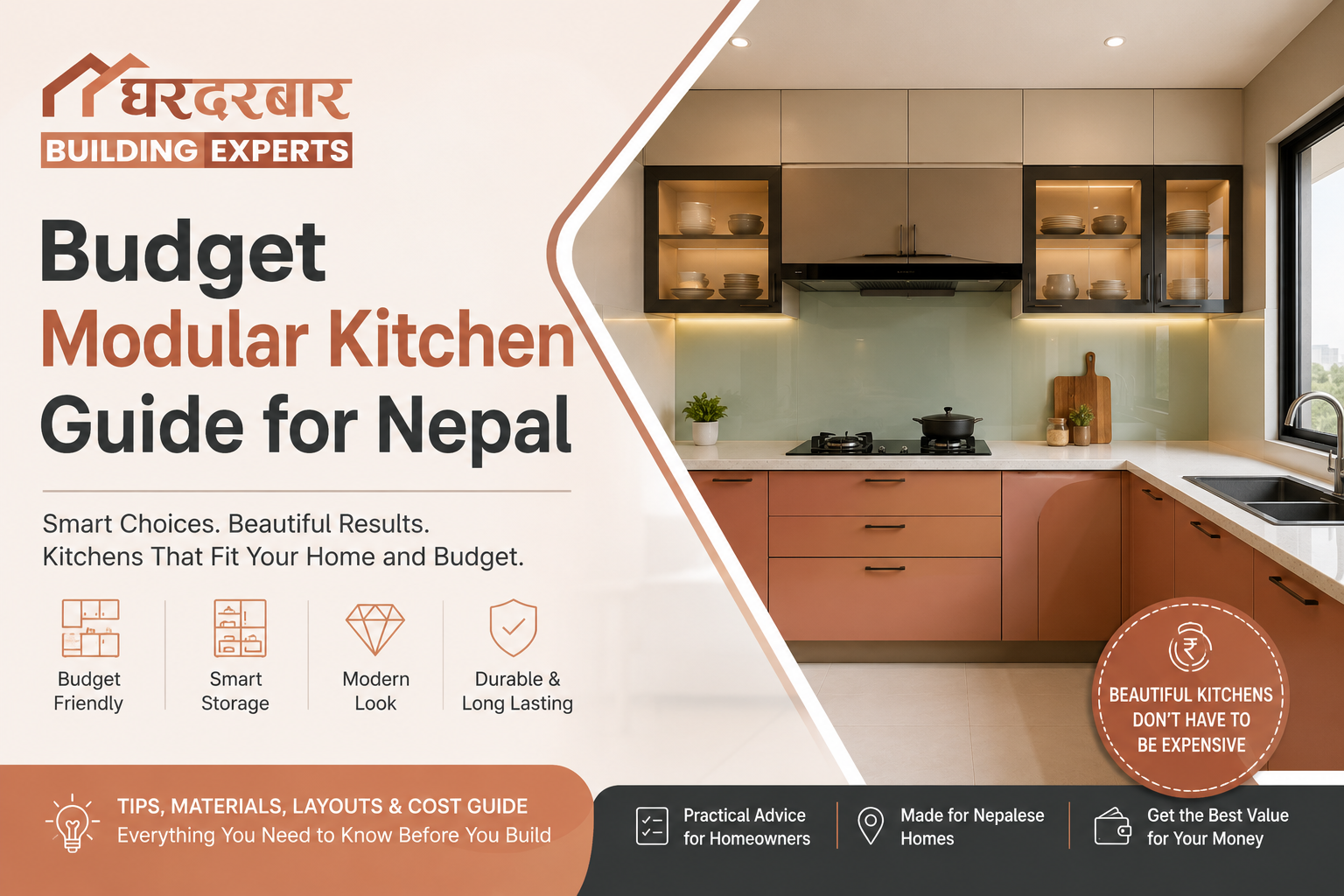
But here's the good news: you don't need to spend a fortune to get a modular kitchen that looks great and works even better. With some smart planning, the right materials, and a few clever tricks, a budget modular kitchen can easily become the most satisfying upgrade your home has ever seen. Smart use of toughened glass for cabinet shutters, kitchen partitions, and backsplashes can instantly elevate the look of a budget kitchen while maintaining durability and safety.
This guide is written specifically for homeowners in Nepal whether you're finishing a new home in Kathmandu, renovating a flat in Pokhara, or setting up a house in the Terai. Let's walk through everything you need to know.
Before we dive into budgets and layouts, let's make sure we're on the same page.
A modular kitchen is built from a set of pre-manufactured units cabinets, drawers, shelves, and countertops that are assembled together like puzzle pieces. Unlike traditional kitchens that are built from scratch on-site (which takes weeks and leaves a lot of dust and uncertainty), modular kitchens are factory-made and then installed in your home in a matter of days.
This approach gives you a few big advantages:
Modern modular kitchen trends in Nepal are also incorporating toughened glass in cabinet doors, kitchen windows, partitions, and backsplashes because of its stylish appearance, heat resistance, and easy maintenance.
And contrary to popular belief, modular kitchens can be designed for any budget. It all comes down to the choices you make.
In India and Nepal, modular kitchen prices typically start from around Rs. 1.5 lakh for a basic straight or L-shaped setup. Mid-range kitchens fall between Rs. 2.5–4 lakh, while premium setups with imported fittings and smart features can go well above Rs. 6 lakh.
For a budget modular kitchen, the sweet spot is usually Rs. 1.5 lakh to Rs. 2.5 lakh and within that range, you can still achieve a kitchen that looks clean, modern, and functional if you're thoughtful about your choices. Adding selective toughened glass features such as glass cabinet shutters or a toughened glass backsplash can still fit comfortably within this budget if planned wisely.
What affects the cost most?
Let's look at each of these one by one.
The layout is probably the single biggest factor controlling your budget. Here's a quick breakdown of which layouts cost less and why:
This is the most affordable layout everything lines up along one wall. It's ideal for smaller kitchens in apartments, rental units, or compact homes. The workflow is simple: cooking, prepping, and cleaning happen along a single linear stretch. It's not glamorous, but it can be made to look sharp with the right finish and smart storage.
Adding a toughened glass backsplash behind the stove or sink can instantly make a straight kitchen look more modern and easier to clean.
Best for: Studio apartments, compact kitchens under 6 feet wide, tight budgets.
The L-shaped layout is the sweet spot for most budget-conscious homeowners. It uses two adjacent walls to create a natural work triangle between the sink, stove, and refrigerator which means less running around while cooking. It also offers better storage than a straight kitchen without the cost of more complex layouts.
An L-shaped kitchen with upper cabinets featuring frosted toughened glass shutters creates a clean and contemporary appearance without making the kitchen feel heavy or cramped.
Best for: Medium-sized kitchens, families who cook regularly, homes where the kitchen opens toward a dining area.
Two countertops facing each other one for cooking and prep, one for storage and appliances. This layout is great for long, narrow kitchens and is quite budget-friendly because it uses two straight runs of cabinets without any complicated corner units.
For narrow kitchens, reflective toughened glass cabinet panels or glossy glass backsplashes can visually make the space appear larger and brighter.
Best for: Narrow kitchens, homes where two people often cook together.
These are beautiful and spacious, but they're also significantly more expensive more cabinetry, more countertop space, more corner fittings. If you're on a tight budget, hold off on these. They're worth it later when you have more to spend.
Premium U-shaped kitchens often use decorative toughened glass partitions and designer glass cabinet shutters to create a luxurious aesthetic.
Best for: Larger kitchens, spacious homes, higher budgets.
Materials are where you can either save a lot or accidentally overspend. Here's what you need to know:
The "box" of your cabinet the structure that holds everything is usually made from one of these:
BWR/BWP Plywood: The most durable option for Indian and Nepali kitchens. Resistant to moisture and humidity, which is critical given the monsoon climate. Slightly more expensive than other options but lasts much longer. Great choice even on a budget if you can stretch a little.
MDF (Medium Density Fibreboard): Smooth, easy to paint or laminate, and cheaper than plywood. The downside? It doesn't handle moisture well. Avoid using it near sinks or in bathrooms.
Particle Board: The most affordable option. Fine for dry areas and low-traffic kitchens, but not ideal for humid environments or heavy everyday cooking.
Our recommendation for Nepal: Given the humid climate across many parts of the country, BWR plywood for base cabinets (near the sink and floor) and MDF for upper wall cabinets is a smart, balanced choice. Pairing these with toughened glass shutters can further improve moisture resistance and visual appeal.
The finish is what you actually see. Here's what works well on a budget:
Laminate: The go-to budget finish. Available in hundreds of colours and textures from wood grains to solid colours to stone-look patterns. Durable, easy to wipe clean, and very affordable. A good quality laminate finish can look surprisingly elegant.
Acrylic: Glossy, reflective, and modern-looking. A step up from laminate in terms of aesthetics, and also easy to maintain. Costs a bit more but gives your kitchen a premium feel without the premium price tag.
Membrane/PVC Foil: A nice middle ground slightly better than basic laminate, with a softer finish and good moisture resistance.
Many homeowners now combine laminate finishes with frosted or clear toughened glass cabinet inserts to create a modern modular kitchen design in Nepal.
Avoid veneer and solid wood finishes if you're on a budget they're beautiful but expensive and require more maintenance.
Countertops can quietly eat up 25–30% of your kitchen budget if you're not careful. Here's how to choose wisely:
Granite: The best value-for-money countertop material. Durable, heat-resistant, scratch-resistant, and naturally beautiful. In Nepal and India, granite is widely available and relatively affordable. Choose neutral shades like grey, black, or brown for a timeless look.
Engineered Quartz: More uniform and elegant than granite, but pricier. Worth considering for a compact kitchen where you need only a small countertop area.
Kota Stone / Natural Stone Slabs: An even more affordable local option in some regions functional but requires sealing.
Avoid imported marble or Corian on a tight budget they look wonderful but cost significantly more.
Here's a truth most kitchen showrooms won't tell you: fancy pull-out systems and motorized fittings are impressive, but they're not necessary for a functional kitchen. Smart layout and simple organisation can do the job just as well at a fraction of the price.
Wire baskets instead of premium pull-outs. A basic wire basket system inside your base cabinets costs far less than a soft-close pull-out drawer system but serves the same purpose. You can always upgrade later.
Tandem drawers over hydraulic systems. Simple tandem drawer channels are durable and affordable. Save the hydraulic damper upgrades for later.
Open shelves for upper storage. Instead of overhead cabinets along the entire wall, use a combination of some closed wall cabinets and open wooden shelves. Open shelves cost significantly less and can look very stylish if kept organised.
Tall pantry unit instead of multiple wall cabinets. A single tall pantry unit from floor to ceiling gives you enormous storage in one go often more efficiently than spreading the same square footage across multiple wall cabinets.
Wall-mounted racks and magnetic strips. These cost almost nothing and free up valuable counter and drawer space. A simple magnetic knife strip, a spice rack on the wall, and a hanging rail for spatulas can dramatically improve your kitchen's functionality.
Whether you're spending Rs. 1.5 lakh or Rs. 10 lakh, this rule never changes. The kitchen work triangle refers to the relationship between your three most-used zones:
These three should ideally form a rough triangle, with no single side of the triangle too long (not more than 9 feet) and no side too short (not less than 4 feet). When these three are positioned well, cooking becomes effortless you're not constantly walking across the kitchen to grab things or wash them.
This is especially important in smaller budget kitchens where every step counts.
Colour is free. Or at least, it costs the same regardless of what shade you choose. So choose wisely.
White and off-white: Timeless, clean, and makes any space look larger. Very forgiving with stains if paired with a good laminate finish.
Light grey or greige (grey-beige): Modern, understated, and pairs well with granite countertops and stainless steel appliances.
Warm wood tones: Woodgrain laminates are incredibly popular and for good reason — they bring warmth, hide minor dust, and look natural and inviting. They've had a huge resurgence in 2025 design trends.
Two-tone combination: Upper cabinets in white or light grey, lower cabinets in a slightly deeper tone (like charcoal, navy, or tan). This two-tone approach looks sophisticated and costs no more than a single colour — it just requires planning.
What to avoid: Very dark colours for small kitchens (they make spaces feel cramped), and very light glossy finishes for busy households (they show fingerprints and smudges more easily).
Here are some specific design ideas that look great and won't drain your savings:
White laminate cabinets, black granite countertop, stainless steel sink, and a single wall-mounted exhaust fan. Add open wooden shelves above the counter for spices and daily-use items. Simple, clean, and incredibly functional for a small apartment. Estimated cost: Rs. 1.5–1.8 lakh.
Woodgrain laminate cabinets on the base, white or cream upper cabinets, a grey granite countertop, and a mosaic tile backsplash. The combination of wood and white looks high-end without the price tag. This layout works well for homes where the kitchen adjoins the living or dining area. Estimated cost: Rs. 2–2.5 lakh.
Light upper cabinets paired with darker lower ones in a galley-style layout. This design maximises storage in a narrow space and gives the illusion of a larger, well-curated kitchen. Add under-cabinet LED strip lighting to make it glow in the evenings. Estimated cost: Rs. 2–2.8 lakh.
A mix of closed cabinets and open shelves perfect for people who love displaying their cookware or plants. The open shelves cost less to install than enclosed wall cabinets, and if styled well, they look beautiful. Use the closed cabinets for items you want to keep out of sight. Estimated cost: Rs. 1.8–2.2 lakh.
Skipping proper measurements. This is the most expensive mistake you can make. Modular units are pre-sized, and if your measurements are off, you'll end up with awkward gaps or units that don't fit. Always measure twice and work with an experienced installer.
Going too cheap on hinges and channels. Cabinet boxes and finishes can be affordable, but always invest in decent quality hinges and drawer slides. Cheap ones break within a year and replacing them in an installed kitchen is a nightmare.
Ignoring ventilation. A kitchen without proper ventilation a chimney or at least a good exhaust fan will collect grease and odours quickly. This affects both hygiene and the longevity of your cabinets. Budget for this upfront.
Underestimating electrical and plumbing. Your modular kitchen will need dedicated points for the hob, chimney, refrigerator, and microwave. If these aren't planned during construction, adding them later is expensive. Coordinate with your electrician and plumber before the kitchen goes in.
Treating the budget as fixed. Always keep a 10–15% buffer. Unexpected costs an extra fitting here, a wall that isn't perfectly straight there are almost universal in kitchen installations.
Absolutely. The Nepali home construction and renovation market has matured significantly over the last decade. Local vendors now offer modular kitchen solutions that match quality standards seen across India and beyond. You no longer need to import units or pay premium prices for a functional, stylish kitchen.
Whether you're in Kathmandu, Lalitpur, Bhaktapur, Pokhara, or Biratnagar there are skilled kitchen installers and material suppliers who can help you design and execute a kitchen that fits your space and your budget.
And remember: a well-designed budget kitchen that's thoughtfully planned will outperform a poorly planned expensive one every single time.
A modular kitchen isn't a luxury item anymore it's a smart, practical investment in how you live every day. The kitchen is where your family gathers, where meals come to life, where mornings begin. Designing it well even on a budget pays dividends in comfort and joy that no balance sheet can fully capture.
Start with the right layout. Choose durable materials. Invest in the small things that matter (like hinges and storage organisers). Get the work triangle right. And let colour, finish, and carefully placed toughened glass elements do the heavy lifting for aesthetics.
You'll be surprised how much kitchen you can get for your money.
Need expert guidance on designing your home's kitchen or interior spaces in Nepal? GharDurbar's team of engineers and architects is here to help. Get in touch with us for a consultation.
Tags: Modular Kitchen Nepal, Budget Kitchen Design, Kitchen Interior Nepal, Home Design Kathmandu, Kitchen Layout Ideas, L-Shaped Kitchen, Modular Kitchen Cost Nepal