Have a project for us?
DO YOU HAVE ANY QUESTIONS REGARDING YOUR NEXT CONSTRUCTION PROJECT?
Published on: May 11, 2026
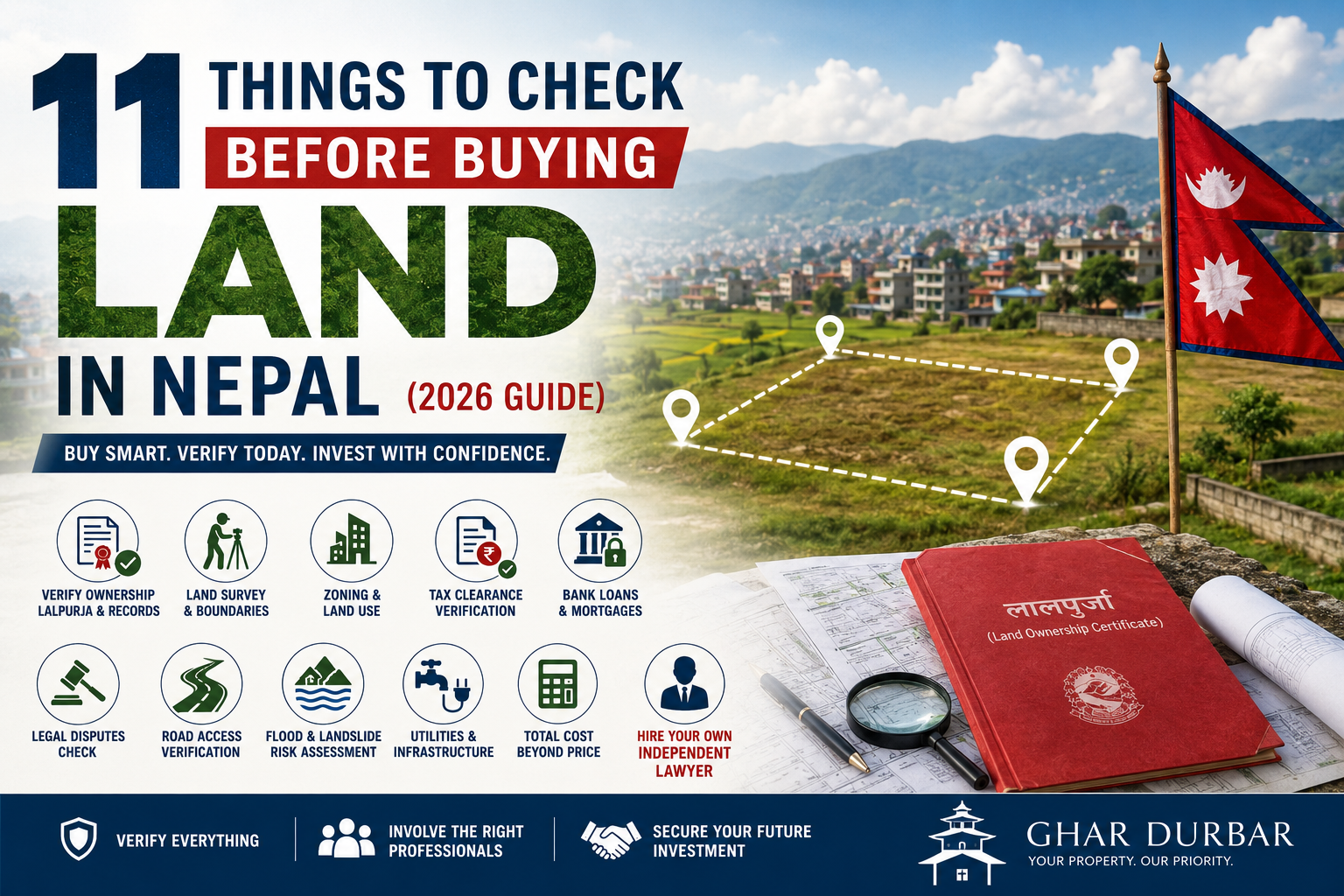
This guide covers the 11 most important things you should check before buying land in Nepal, explained in simple, practical language without complicated legal jargon.
Nepal’s property market is growing rapidly, especially in cities like Kathmandu, Pokhara, and expanding suburban areas around the Valley. But with rising land demand, cases of:
have also increased.
A little verification today can save you from years of stress, court cases, and financial loss later.
The very first thing you should check is the Lalpurja, also commonly called the Ratopurja. This is the official land ownership certificate in Nepal and the most important document in any land transaction.
Never rely only on photocopies or scanned images. Ask to see the original document.
Carefully verify:
The seller’s name on the Lalpurja should exactly match their citizenship certificate. Even small spelling mismatches can create legal complications during registration.
You should also cross-check the ownership details at the local Malpot Karyalaya (Land Revenue Office) before making any payment.
If the seller avoids showing the original Lalpurja or keeps giving excuses, treat it as a serious warning sign.
One of the most common land problems in Nepal is that the physical plot on the ground doesn’t match the documents on paper.
Boundary disputes and encroachments are surprisingly common.
Hire a certified surveyor from Nepal’s Survey Department to verify:
A proper survey ensures that the land you are paying for actually exists in the size and location mentioned in the documents.
Talk to neighbouring landowners during your visit. Local residents often know about old disputes, shared boundaries, or hidden problems that official documents may not show.
Not every plot can legally be used for every purpose.
In Nepal, land is categorized into:
For example, you generally cannot build residential housing on agricultural land without approval and conversion processes.
Before buying, visit your:
and verify the official land-use classification.
Also ask whether the land falls under:
These projects can significantly reduce the usable area or future value of your land.
Many buyers forget this step and later discover unpaid taxes attached to the property.
Before finalizing the deal, verify that the seller has paid:
Request a Tax Clearance Certificate from the Land Revenue Office.
If taxes remain unpaid, the liability can transfer to you after purchase.
Also clarify who will pay the Capital Gains Tax during the transfer process. Legally, this is usually the seller’s responsibility, but misunderstandings during negotiations are common.
A plot may look legally clean but still be tied to a bank loan.
In Nepal, many landowners use property as collateral for loans. If the loan hasn’t been cleared, the bank still has legal rights over that land — even after you buy it.
Before making payment:
Never agree to “pay first so the seller can clear the loan later.”
The mortgage must be officially cleared before ownership transfer.
Some land plots in Nepal are involved in:
Buying disputed land means inheriting someone else’s legal problem.
Verify legal status through:
Do not rely solely on verbal assurances from sellers or brokers.
A qualified real estate lawyer can usually perform these checks quickly and affordably.
Road access directly affects:
Land without legal road access can become extremely difficult to use or sell.
Check:
Also make sure the road access is officially documented not based on informal neighbour agreements.
Visit the area during both dry and rainy seasons if possible. Some roads become inaccessible during monsoon months.
Nepal is highly vulnerable to:
Before buying land, assess the environmental and geological risks carefully.
Check:
Beautiful hillside plots may require expensive retaining walls and foundation work.
Talk to long-term local residents. They often know the history of floods, cracks, or landslides in the area better than official reports.
Many buyers assume utilities are available only to discover later that they are not.
Before purchasing, verify actual availability of:
Also check nearby access to:
These factors strongly affect both quality of life and future property value.
For water supply, confirm whether the area receives regular service or depends mainly on tanker water.
The advertised land price is only part of the total expense.
Additional costs in Nepal typically include:
| Expense | Estimated Cost |
| Registration Tax | 4–6% |
| Stamp Duty | 1–2% |
| Survey Fees | Varies |
| Lawyer Fees | Varies |
| Agent Commission | Optional |
| Documentation Charges | Varies |
In many cases, total transaction costs can add another 7–8% or more on top of the land price.
Get an independent property valuation before making an offer. It helps avoid overpaying and gives you stronger negotiation power.
This may be the single most important advice in the entire process.
Many buyers either:
That creates a conflict of interest.
Hire your own independent real estate lawyer who works only for you.
A good lawyer will help you:
Compared to the price of the land itself, lawyer fees are relatively small but they can save you from massive future losses.
After registration, safely store all original documents including:
You’ll need them for future resale, bank loans, or legal matters.
| What to Check | Where to Verify |
| Lalpurja / Ownership | Land Revenue Office |
| Physical Survey & Boundaries | Certified Surveyor |
| Zoning Classification | Municipality / Ward Office |
| Tax Clearance | Malpot Office |
| Bank Loan / Mortgage Status | Bank + Malpot |
| Legal Disputes | District Court |
| Road Access | Site Visit + Documents |
| Flood / Landslide Risk | Municipality + Locals |
| Utilities | NEA / Water supply office |
| Total Purchase Cost | Lawyer + Malpot |
| Legal Verification | Independent Property Lawyer |
Buying land in Nepal doesn’t have to be stressful as long as you take your time and verify everything properly.
The smartest land buyers are not the fastest buyers. They are the ones who ask questions, check documents carefully, and involve the right professionals before signing anything.
At Ghar Durbar, we help homeowners, investors, and families navigate Nepal’s property market with transparency and confidence from finding the right plot to understanding legal procedures and planning construction properly.
If you’re planning to buy land in Nepal in 2026, use this checklist as your starting point and make your investment with confidence.